
Soil Nutrition
Texas Soil Nutrient Deficiencies Chart
Summary of Patterns Across Texas
Understanding the Texas Soil Nutrient Deficiency Charts
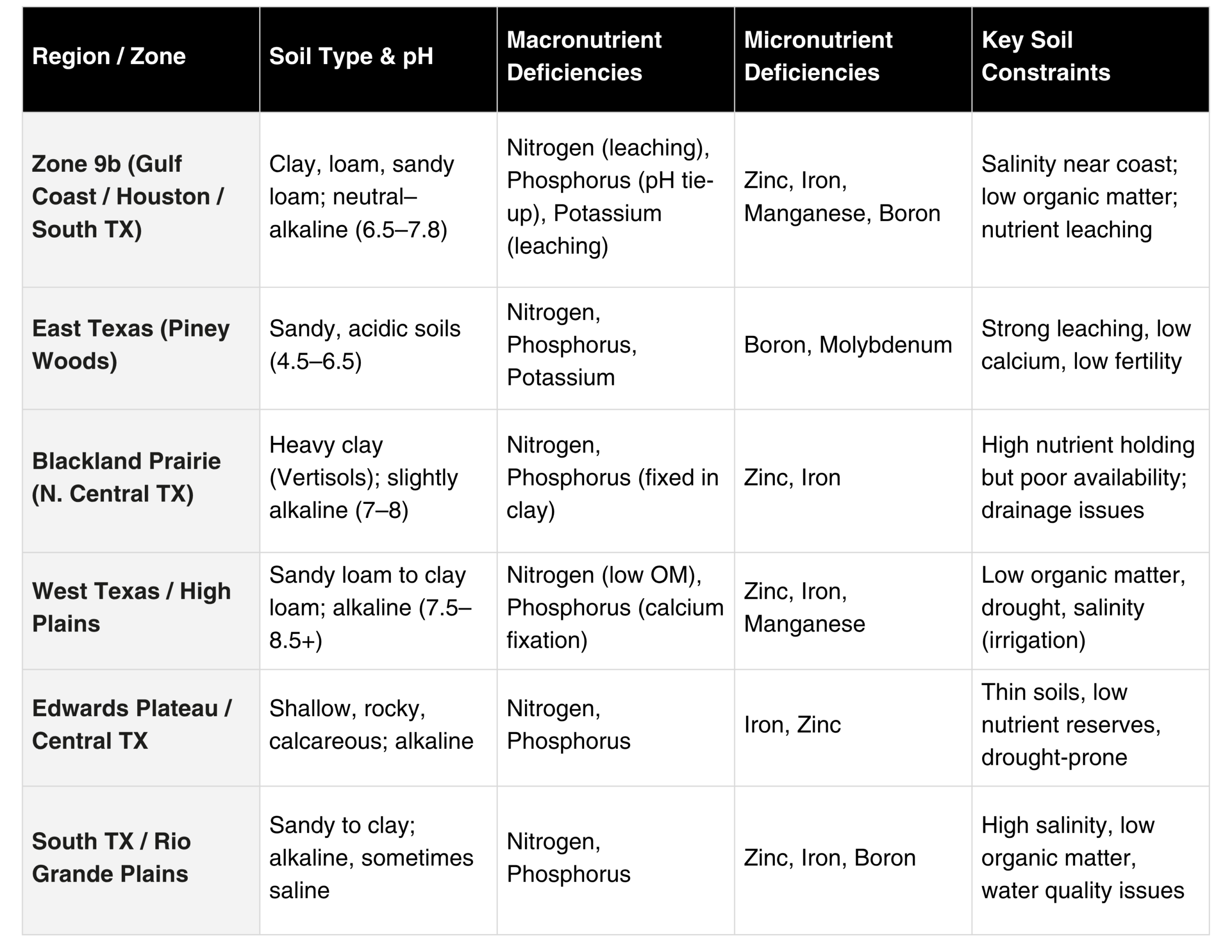
The charts above are designed to provide a clear, visual summary of how soil nutrient limitations vary across Texas regions, with special emphasis on Zone 9b (Gulf Coast and Houston area). Because Texas soils are highly diverse—ranging from sandy and acidic in the east to clay-heavy and alkaline in the west—nutrient availability is not uniform across the state. [CodeInterpreter | Undefined], [cultivatingflora.com]
These visual tools simplify complex soil science concepts into color-coded, easy-to-read formats for quick reference in the field, during planning, or when selecting fertilizers.
How to Read the Charts
1. Region
This identifies the major soil zones across Texas, including:
Zone 9b (Gulf Coast / Houston), East Texas (Piney Woods), Blackland Prairie, West Texas / High Plains, Central Texas (Edwards Plateau), South Texas (Rio Grande Plains)
These regions differ in soil texture, rainfall, organic matter, and pH, all of which influence nutrient behavior in soil.
2. Macronutrient Deficiencies (Red)
The red-colored column highlights deficiencies in primary nutrients required in large amounts:
- Nitrogen (N): Essential for plant growth and leaf development
- Phosphorus (P): Important for root growth and energy transfer
- Potassium (K): Critical for water regulation and stress tolerance
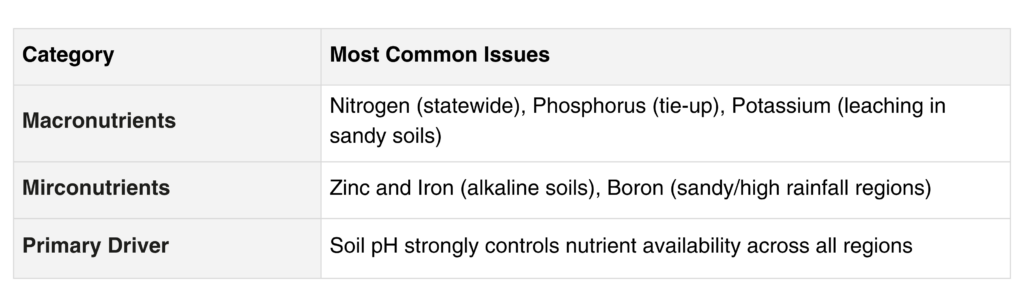
Across Texas, nitrogen is the most consistently deficient nutrient, largely due to:
- Low organic matter
- Leaching in sandy or high-rainfall areas
Phosphorus is also widely limited, not because it is always absent, but because it becomes chemically unavailable (“fixed”) in both acidic and alkaline soils.
3. Micronutrient Deficiencies (Orange)
The orange-colored column shows micronutrients needed in smaller quantities but still essential for plant health:
- Zinc (Zn) – enzyme function and growth regulation
- Iron (Fe) – chlorophyll production (often causes yellowing leaves if lacking)
- Manganese (Mn) – photosynthesis and enzyme activation
- Boron (B) – cell wall development and reproductive growth
- Molybdenum (Mo) – nitrogen metabolism
In Texas:
- Zinc and iron deficiencies are most common in alkaline soils (Central, West, and South Texas)
- Boron deficiencies appear more often in sandy, high-rainfall areas like East Texas.
The Soil Factory™ ©2026 All Rights Reserved.